

The Hoka Clifton 11 costs $155. For runners drawn to maximum cushioning, that price has become harder to justify.
Through three and a half decades of running, I’ve watched Hoka go from a fringe brand making “clown shoe” maximalist trainers to one of the most recognizable names in running. The Clifton became their signature daily trainer — the shoe that helped popularize the high-stack, soft-cushion category that now dominates the market.
But the Clifton’s price reflects more than engineering. It reflects brand power. And several cheaper shoes now deliver a similar, or arguably better, max-cushion experience for less.
If you’re weighing the cheaper Hoka Clifton alternatives, here’s what the specs, reviewer consensus, and current pricing actually show.
Short on time? These are the four I’d look at first. The full comparison is below.
Same shoe underneath as the 11 (same stack, drop and midsole), now about $15-20 less on Amazon as clearance stock thins out. A fit you already know.
Men’s on AmazonWomen’s on AmazonNearly the same cushioning as the Clifton, lighter, with livelier foam. Discounted since the Novablast 6 replaced it.
Men’s on AmazonWomen’s on AmazonLower stack and more responsive, closer to how the older Cliftons felt. Now around $110-115, still about $40 under the Clifton 11.
Men’s on AmazonWomen’s on AmazonA durable workhorse with more ground feel. With the Pegasus 42 out, it’s around $105-125.
Men’s on AmazonWomen’s on AmazonClearance stock and prices change quickly, so check your size. These are affiliate links: if you buy, I may earn a small commission at no extra cost to you. Disclosure.
What’s in this comparison
What Makes the Hoka Clifton Popular
The Clifton has been one of running’s best-selling shoes since 2014. Knowing what made it iconic is the first step in judging whether something cheaper can stand in for it.
Maximum cushioning at a moderate weight. Reviewer consensus is consistent — the Clifton delivers a high-stack ride without feeling clunky. The Clifton 11 carries a 42mm heel and 34mm forefoot stack, firmly in max-cushion territory, at roughly 9.9 oz per Hoka’s own spec.
Meta-Rocker geometry. Hoka’s curved midsole assists transitions through the gait cycle. Multiple reviews credit this rocker for making a shoe with this much foam feel manageable rather than like a brick.
8mm drop. The Clifton 10 raised the drop from the line’s traditional 5mm to 8mm, and the 11 keeps it there. Hoka’s reasoning is that softer foams and taller heel stacks create a “weighted drop” effect under compression, so 8mm is meant to feel closer to the classic Clifton once you’re actually running on it.
CMEVA midsole — and this is the sticking point. The Clifton 11 uses the same compression-molded EVA as the 10. It’s stable and durable, but it trails the supercritical, nitrogen-infused, and PEBA-based foams competitors now use at this price. Reviewers have been blunt about it: protective rather than bouncy, with energy return that lags the category.
Wide width availability. Three widths — regular, wide, and extra-wide. For runners with non-standard feet that’s a real advantage, and if you’ve ever gone hunting for a decent extra-wide trainer you’ll know how short that list gets.
Crossover appeal. The Clifton is as much a lifestyle shoe as a running shoe now, and a large share of sales go to people walking and standing in them rather than training (which is worth remembering when you read reviews of it).
So the appeal isn’t cutting-edge technology. It’s brand recognition, fit consistency, width options, and that rocker. The question is whether those justify $155 when competitors offer better foam for less.
What Changed in the Clifton 11 (And What Didn’t)
Short version: not much underfoot.
The Clifton 11 arrived in mid-2026 at $155, five dollars up from the 10. Hoka kept the 42mm heel stack, the 8mm drop, and the compression-molded EVA midsole. What changed sits above the foam — a softer engineered upper, some added structure, a better insole, and low-light visibility details. Runners who found the 10 snug through the midfoot report the 11 fits more accommodatingly. Three widths, as before.
So if you were hoping the 11 would answer the foam criticism, it doesn’t. The ride is the same calm, protective, not-especially-bouncy experience the 10 delivered. Fine if that’s what you want — but it means everything below about cheaper alternatives applies just as much to the 11 as it did to the 10.
So should you upgrade from the 10 to the 11? Probably not, if your 10s still have life in them. The changes are refinements to the upper, not a new shoe. If you’re due for a replacement anyway, the 11 is the better version. If you’re not, there’s no performance reason to rush.
One thing worth knowing: Hoka also released the Clifton Pro alongside the 11, at about $10 more. Same last, same drop, but with a supercritical foam and a more aggressive rocker. That’s Hoka’s own answer to the foam complaint. It’s a step up in price rather than down, so it sits outside the remit of this article — but if the foam is the only thing holding you back from the Clifton, it’s the shoe to look at.
Coming From the Clifton 9 or Clifton 8?
This deserves its own section, because a lot of runners arrive here after loving an older Clifton and finding the new one doesn’t feel the same. They’re right, and it isn’t their imagination.
The Clifton 9 and 8 were meaningfully different shoes. The 9 ran a 5mm drop on a lower stack, at around 8.7 oz. The 10 redesigned the platform — taller stack, 8mm drop, more weight. So if you’re searching for shoes similar to the Hoka Clifton 9, what you’re often after isn’t a max-cushion shoe at all. It’s the lighter, lower, more nimble ride the 9 had.
If you loved the Clifton 9 or 8 and don’t want the taller platform, the closest matches are the lower-stack options further down this page — the Saucony Ride and the Nike Pegasus both sit closer to the old Clifton’s proportions than the current Clifton does. Hoka’s own Mach line is also a lighter, lower alternative that keeps the rocker feel.
If you liked the 9 and are fine with more foam, the Clifton 11 or a clearance Clifton 10 will feel familiar in fit and rocker, just taller and softer underfoot.
Worth being clear about this, because “the newest version of the shoe I liked” and “the shoe most similar to the one I liked” are not always the same answer. (It catches a lot of runners out.)
Four Cheaper Alternatives Worth Considering
A note on how to read this section, because it’s the part that saves the most money.
Every one of these four has been updated in 2026 — the Novablast is on version 6, Saucony on the Ride 19, Brooks on the Glycerin 23, Nike on the Pegasus 42. That matters, because the previous generation of each is now on clearance, usually at a substantial discount, and in most cases the differences are modest. Buying last year’s model is the single most reliable way to get premium cushioning at a budget price.
I’ll give you both: the current version, and the outgoing one that’s the better buy while stock lasts.
A quick note on how I write these: I haven’t personally logged hundreds of miles in each of these specific shoes. What follows draws on specs and reviewer consensus, combined with a long time spent learning (sometimes the hard way) what actually matters in a cushioned trainer. Where I’m citing testers, I’ll say so.
1. ASICS Novablast — the closest match
Specifications (Novablast 5):
- Stack: 41.5mm heel, 33.5mm forefoot
- Drop: 8mm
- Weight: ~9.0 oz (men’s size 9)
- Midsole: FF Blast Max
The ASICS Novablast 5 is the most direct Clifton competitor in spec, philosophy, and value — and now that the Novablast 6 has replaced it at $155, the 5 has dropped to around $130. That makes it the best value here if you want the full Clifton-height stack.
Key differences from the Clifton:
- Nearly identical stack height (41.5mm vs 42mm heel)
- Identical 8mm drop
- Close to a full ounce lighter
- FF Blast Max returns more energy than the Clifton’s CMEVA
- Wider toe box than earlier Novablast versions
Trade-offs:
- Outsole grip on wet roads is a known weakness in the 5 (improved in the 6)
- Two widths versus the Clifton’s three
- Fits narrower than the Clifton overall
Which version to buy: The Novablast 5 on clearance is the value pick and the reason this shoe tops the list. If it’s sold out in your size, the Novablast 6 at $155 is lighter again, with better outsole rubber — but at that price it’s no longer undercutting the Clifton, so the saving disappears.
2. Saucony Ride — the lower-stack option
Specifications (Ride 17):
- Stack: 35.5mm heel, 27.5mm forefoot
- Drop: 8mm
- Weight: ~9.9 oz (men’s size 9)
- Midsole: PWRRUN
The Saucony Ride 17 sits a tier below the Clifton in cushioning but offers a more versatile, responsive ride — and with Saucony now on the Ride 19, older versions are widely discounted. The Ride 17 now sells for around $110-115, about $40 under the Clifton 11.
Key differences from the Clifton:
- Lower stack (35.5mm vs 42mm) — moderate rather than maximum cushioning
- Same 8mm drop
- Lighter
- PWRRUN is more responsive than CMEVA
- Closer-to-the-ground feel
Trade-offs:
- Not a true max-cushion alternative
- Narrower through the midfoot than the Clifton
- Two widths
Who it’s for: Runners who conclude that 42mm of stack is more than they need — and, per the section above, anyone chasing the feel of an older Clifton rather than the current one. Plenty of runners who think they want maximum cushioning are happier on something lighter and more responsive.
3. Brooks Glycerin — the plush option
Specifications (Glycerin 22):
- Stack: 38mm heel, 28mm forefoot
- Drop: 10mm
- Weight: ~10.1 oz (men’s size 9)
- Midsole: DNA Tuned, nitrogen-infused
The Brooks Glycerin 22 sits in the same plush daily-trainer category as the Clifton, and with the Glycerin 23 now out, the 22 turns up discounted regularly.
Key differences from the Clifton:
- Slightly less stack but still firmly max-cushion
- Higher 10mm drop
- Comparable weight
- Nitrogen-infused foam — softer, with better energy return than CMEVA
- Brooks matches Hoka on width options
Trade-offs:
- Only a value play when discounted; at full retail it’s no cheaper than the Clifton
- Heavier than the ASICS or Saucony options
- Less pronounced rocker
Who it’s for: Runners who want plush cushioning with modern foam and need the wider width options, and who can find the outgoing version on sale.
4. Nike Pegasus — the workhorse
Specifications (Pegasus 41):
- Stack: 37mm heel, 27mm forefoot
- Drop: 10mm
- Weight: ~9.6 oz (men’s size 9)
- Midsole: ReactX with forefoot Air Zoom
The Nike Pegasus 41 represents a different philosophy — lower stack, more ground feel, excellent durability. With the Pegasus 42 out, the 41 is down to around $105 to $125.
Key differences from the Clifton:
- Notably less stack — moderate, not maximum cushioning
- Higher 10mm drop
- Slightly lighter
- ReactX is more responsive than CMEVA
- Air Zoom unit adds forefoot pop
Trade-offs:
- Not a max-cushion alternative if that’s specifically what you want
- Firmer ride than the Clifton’s plush sensation
- Narrower fit
Who it’s for: Runners who realize they don’t need maximum cushioning and want a durable, versatile trainer at the lowest price here.
The Cheapest Clifton Is Last Year’s Clifton
Here’s the option most people overlook the moment a new model lands.
The Hoka Clifton 10 is the same shoe underneath as the Clifton 11 — same 42mm stack, same 8mm drop, same CMEVA midsole. What you give up is the 11’s softer upper and improved insole. What you get back depends on timing. Early in the clearance cycle it was $25 to $55; on Amazon right now it’s closer to $15 to $20, because the stock has thinned out.
If you’ve been wondering why the Clifton 10 is suddenly on sale everywhere, that’s why. It isn’t a defect or a clearance of unsold stock — it’s the standard cycle every time a new version ships.
Choose the Clifton 10 if: you want the Clifton ride and don’t care about the newest upper. This is the most efficient way to get it.
Choose the Clifton 11 if: you specifically want the improved fit and insole, you need a size or width the 10 has sold out of, or you’d rather buy a shoe that will still be available when you want a second pair.
But the catch with clearance is always the same. Sizes and colourways thin out fast, and once the stock is gone, it’s gone.
Head-to-Head: What You’re Trading
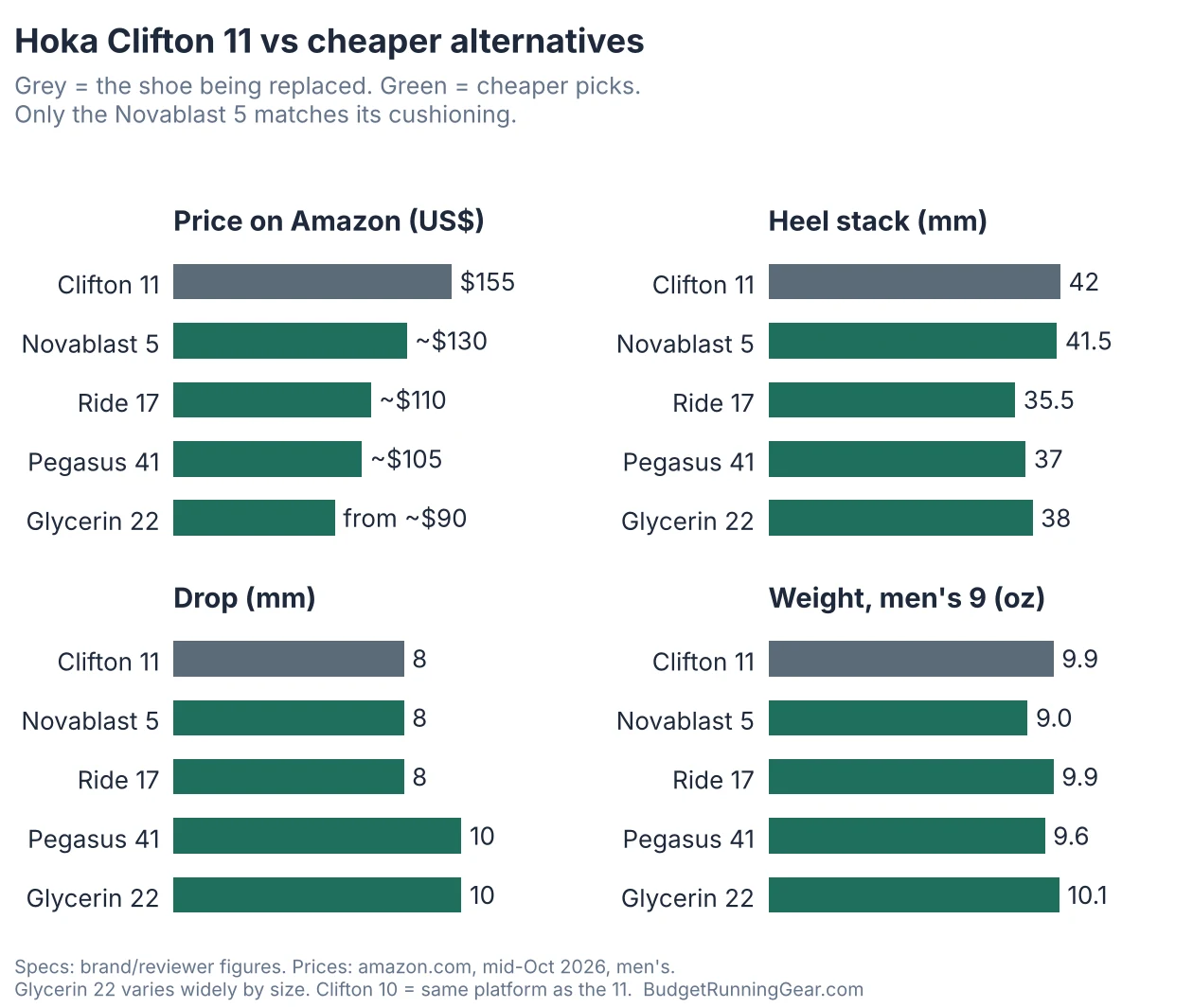
All the numbers in one place first, then what they mean below.
| Shoe | Buy on Amazon | Typical price (Amazon) | You save vs Clifton 11 | Heel stack | Drop | Weight (men’s 9 / women’s 8) | Widths |
|---|---|---|---|---|---|---|---|
| Hoka Clifton 11 | Men’s | Women’s | $155 | (reference) | 42mm | 8mm | ~9.9 / 8.2 oz | 3 |
| Hoka Clifton 10 | Men’s | Women’s | ~$135-140 | ~$15-20 | 42mm | 8mm | ~9.8 / 8.0 oz | 3 |
| ASICS Novablast 5 | Men’s | Women’s | ~$130 | ~$25 | 41.5mm | 8mm | ~9.0 / 7.9 oz | 2 |
| Saucony Ride 17 | Men’s | Women’s | ~$110-115 | ~$40 | 35.5mm | 8mm | ~9.9 / 8.4 oz | 2 |
| Nike Pegasus 41 | Men’s | Women’s | ~$105-125 | ~$30-50 | 37mm | 10mm | ~9.6 / 8.7 oz | 2 |
| Brooks Glycerin 22 | Men’s | Women’s | from ~$90 (varies by size) | up to ~$65 | 38mm | 10mm | ~10.1 / — oz | several |
Cushioning Volume
- Clifton 11: 42mm heel / 34mm forefoot — maximum
- Clifton 10: identical to the 11
- Novablast 5: 41.5mm / 33.5mm — virtually identical to the Clifton
- Ride 17: 35.5mm / 27.5mm — moderate
- Glycerin 22: 38mm / 28mm — high
- Pegasus 41: 37mm / 27mm — moderate
Only the Novablast truly matches the Clifton’s stack. The others offer less foam, which is a feature if you don’t need 42mm and a deal-breaker if maximum cushioning is what drew you to the Clifton.
Foam and Energy Return
- Clifton 11 and 10: CMEVA — stable and durable, but mediocre energy return
- Novablast 5: FF Blast Max — softer and bouncier
- Ride 17: PWRRUN — more responsive
- Glycerin 22: DNA Tuned, nitrogen-infused — better return
- Pegasus 41: ReactX with Air Zoom — responsive with forefoot pop
This is where the Clifton most visibly trails. All four alternatives use more modern foam. Reviewer consensus identifies CMEVA as the Clifton’s main weakness, and the 11 didn’t change it.
Weight
- Clifton 11: ~9.9 oz (per Hoka’s spec)
- Novablast 5: ~9.0 oz
- Ride 17: ~9.9 oz
- Glycerin 22: ~10.1 oz
- Pegasus 41: ~9.6 oz
Only the Glycerin is heavier. Every other alternative here is lighter than the Clifton, the Novablast by close to a full ounce. Manufacturers quote weights at different sample sizes, so treat these as close rather than exact.
Width Availability
- Clifton 11 and 10: three widths — regular, wide, extra-wide
- Glycerin 22: multiple widths, comparable to Hoka
- Novablast 5, Ride 17, Pegasus 41: two widths each
Hoka and Brooks lead here. If you need extra-wide, the Clifton or the Glycerin may be your only realistic options.
When the Hoka Clifton Is Worth $155
Despite cheaper alternatives performing competitively, specific cases favour the Clifton:
1. Wide or extra-wide feet. Hoka’s three-width availability is a real advantage. ASICS, Saucony, and Nike offer two.
2. Established Clifton compatibility. If you’ve run multiple cycles in Cliftons without issues, the consistency between versions minimizes injury risk. Switching platforms always introduces variables.
3. Crossover lifestyle use. If you’ll wear these casually as much as for running, the Clifton’s recognized look and broad acceptance as everyday footwear has value.
4. You want current-season availability. Clearance models sell out. If you want to buy the same shoe again in six months, the current version is the safer choice.
When Cheaper Alternatives Make More Sense
Best max-cushion alternative — ASICS Novablast 5: Nearly identical stack to the Clifton, lighter, better foam, and now on clearance since the 6 arrived. The clearest “Clifton at a discount” option.
Cheapest route to the Clifton ride — Hoka Clifton 10: Same shoe as the 11 underneath, currently about $15-20 less on Amazon. Buy it while the sizes last.
Best moderate-cushion alternative — Saucony Ride 17: Less stack, lighter, more responsive, much cheaper. Also the closest feel to an older Clifton.
Best plush alternative — Brooks Glycerin 22: Modern nitrogen-infused foam with wide width options. Best when discounted.
Best budget workhorse — Nike Pegasus 41: Durable and versatile at the lowest price here.
The Bottom Line
The Hoka Clifton 11 is a competent, popular max-cushion daily trainer. Its rocker geometry, width availability, and brand consistency have real value.
But at $155 it’s priced above its foam technology. Reviewer consensus is steady: the CMEVA midsole trails the modern foams competitors use at the same or lower prices, and the 11 didn’t change it.
Recommendation hierarchy:
- ASICS Novablast 5 (~$130): Best overall — near-identical cushioning, better foam, lighter, cheaper
- Hoka Clifton 10 (clearance): The Clifton ride for a bit less than the 11 (about $15-20 on Amazon right now)
- Saucony Ride 17: Best for runners who don’t need max cushioning, or who preferred the older Cliftons
- Brooks Glycerin 22: Plush max-cushion with modern foam, when discounted
- Nike Pegasus 41: Best workhorse at the lowest price
- Hoka Clifton 11 ($155): Worth it for extra-wide widths, established Clifton fit, or current-season availability
- ASICS Novablast 6 ($155): If the 5 is sold out in your size
So, bottom line: for most runners drawn to the Clifton, the Novablast 5 on clearance delivers more for less. And if it’s specifically the Clifton you want, last year’s model is the same shoe for meaningfully less money. Either way, spend what you save on something that actually rewards it — good socks, or just more time out the door.
Frequently Asked Questions
What is the best cheap alternative to the Hoka Clifton?
The ASICS Novablast 5 is the closest match — 41.5mm heel stack against the Clifton’s 42mm, the same 8mm drop, close to an ounce lighter, and a more modern foam. Now that the Novablast 6 has replaced it, the 5 is discounted, which makes it the clearest value pick. For runners who don’t need maximum cushioning, the Saucony Ride 17 is cheaper again.
What shoes are comparable to the Hoka Clifton?
In stack height and ride character, the ASICS Novablast is the closest comparison — similar cushioning volume, the same drop, with better energy return. The Brooks Glycerin offers similar plushness with a different rocker profile. Both typically cost less than the Clifton, especially in their outgoing versions.
Is there a Hoka Clifton dupe?
If you mean a shoe that delivers the same max-cushion, rockered ride for less, the ASICS Novablast 5 is the one most reviewers land on. Nearly the same stack, lighter on foot, livelier foam. The cheapest route to an actual Clifton ride, though, is a clearance Clifton 10 — same shoe, older upper, lower price.
What is the Hoka Clifton equivalent from other brands?
There’s no exact equivalent, because the Meta-Rocker geometry is specific to Hoka. But for the combination of high stack, neutral platform, and cushioned daily-trainer role, the ASICS Novablast and Brooks Glycerin are the closest from other brands, and both use more modern midsole foams.
What shoes are similar to the Hoka Clifton 9?
This is a more interesting question than it looks, because the Clifton 9 was a different shoe from the current one — a 5mm drop on a lower stack, at around 8.7 oz. If what you liked was that lighter, lower ride, the current Clifton isn’t the closest match to it. The Saucony Ride 17 and Nike Pegasus 41 sit closer to the old Clifton’s proportions, and Hoka’s Mach line keeps the rocker in a lighter package. If you’re fine with more foam, the Clifton 11 or a clearance Clifton 10 will feel familiar in fit and rocker, just taller.
Why is the Hoka Clifton 10 on sale?
Because the Clifton 11 replaced it. Retailers discount the outgoing version every time a new model ships — it isn’t a sign of a problem with the shoe. Since the 11 kept the same midsole, stack, and drop as the 10, you’re getting the same ride for less. The only real catch is that sizes and colours sell out.
What’s the difference between the Hoka Clifton 10 and 11?
Underfoot, nothing meaningful — same 42mm heel stack, same 8mm drop, same CMEVA midsole. The 11 has a softer engineered upper, added structure, a better insole, and a slightly roomier midfoot. Real refinements, but not a new shoe. If your 10s still have miles left, there’s no performance reason to upgrade.
Is the Hoka Clifton worth $155?
For most runners, it’s a close call. It’s comfortable, durable, and comes in three widths — but it reuses a compression-molded EVA foam that already trailed competitors in the 10, and several cheaper shoes deliver more energy return. It earns the price if you need extra-wide sizing, you’ve run happily in Cliftons for years, or you wear them as much for walking as for running.
Is the Hoka Clifton good for beginners?
Yes, but cheaper alternatives are equally beginner-friendly. The neutral platform, moderate weight, and well-padded ride suit new runners well. The Novablast and Ride offer similar beginner-appropriate features for less, which frees up money for other essentials. Beginners benefit more from a shoe that fits properly than from any particular brand.
How long do Hoka Clifton shoes last?
Typically 400-500 miles of functional life, similar to most premium daily trainers. The CMEVA midsole is durable and resists compression well, though the exposed foam areas of the outsole can show wear earlier than the midsole’s functional limit.
Related Articles:
Hoka Bondi Alternatives: 4 Cheaper Shoes That Match It
Brooks Ghost vs Cheaper Alternatives