

Short on time? These are the four Brooks Adrenaline alternatives I’d look at first. The full comparison is below.
Clearance stock and prices change quickly, so check your size. These are affiliate links: if you buy, I may earn a small commission at no extra cost to you. Disclosure.
Same stack, drop and GuideRails support as the new GTS 26, now about $125 as stock clears. Reviewers say the fit matches earlier Adrenalines, and it comes in four widths.
Men’s on AmazonWomen’s on AmazonLighter, with bouncier foam and similarly unobtrusive support. Around $110 now that the GT-2000 15 is out. Reviewers flag a narrow toe box, so consider the wide.
Men’s on AmazonWomen’s on AmazonSoft, roomy stability shoe with a lower 6mm drop. From about $85 since the Guide 19 replaced it.
Men’s on AmazonWomen’s on AmazonTwo versions back: firmer foam and a steeper 12mm drop. Around $100-130 while sizes last.
Men’s on AmazonWomen’s on AmazonThe Brooks Adrenaline GTS 26 costs $155. It ships on 1 Nov, and it’s the latest version of what has been the default stability shoe for 25 years. If you overpronate and you’ve been in Adrenalines for a while, there’s a good chance you’ll just buy the next one. And that’s fine!
But you don’t have to pay $155 for it. Right now the best Brooks Adrenaline alternatives are shoes the new season has pushed onto clearance. The new model’s arrival has already pushed the GTS 25 down to about $125, and two of the best-known rival stability shoes are on clearance too. Here’s what you give up (and what you don’t) at each price.
What’s in this comparison
What Makes the Brooks Adrenaline Popular
The Adrenaline’s appeal is mostly about not having to think about it.
- GuideRails support: instead of a hard medial post, Brooks uses raised rails along the heel to keep excess movement in check, so the support stays out of the way until you need it.
- Four widths: narrow, standard, wide and extra wide in men’s sizes, which few brands match.
- A consistent fit: each new version feels much like the last one, so long-time wearers can reorder with confidence.
- Durability: reviewers consistently rate the outsole well above average.
None of that is cutting-edge, of course. DNA Loft v3 is a solid foam but not a lively one, and the shoe is on the heavy side at close to 11 oz. So the question is whether that familiarity is worth $155 when the same kind of support is available for less.
What Changed in the GTS 26 (And What Didn’t)
Not much underfoot. Going by Brooks’ published specs, the GTS 26 keeps the GTS 25’s stack (about 36mm heel, 26mm forefoot), its 10mm drop, the GuideRails system and the $155 price. The DNA Loft v3 midsole is re-tuned for a slightly more responsive toe-off. The real changes are up top: a softer flat-knit tongue, a refreshed collar and a heel loop for easier on and off. It’s also a touch heavier, at 10.8 oz (men’s).
In other words, it’s a fit-and-feel update, not a new shoe. Which is exactly why last year’s version is the bargain here.
The Cheapest Adrenaline Is Last Year’s Adrenaline
Here’s the option most people overlook the moment a new model lands. It’s the same pattern as with the Hoka Clifton and the Brooks Ghost: the new version gets the attention, and last year’s version quietly becomes the bargain.
Brooks Adrenaline GTS 25 — ~$125
The Adrenaline GTS 25 is the same platform as the GTS 26 underneath: same stack, same 10mm drop, same GuideRails and the same four widths. Its price has come down from $155 to about $125 ahead of the GTS 26 launch.
The 25 was itself a bigger change than the 26. Compared with the GTS 24, it got a softer midsole (lab testing found it noticeably softer), more foam under the forefoot and a drop that came down from 12mm to 10mm. So if you’re coming from an older Adrenaline, the 25 is the one that will feel newest.
Sizing: reviewers describe the fit as consistent with earlier Adrenalines, so stay with your usual size and width.
Choose the GTS 25 if: you want the Adrenaline and don’t need the newest tongue and collar. This is the most efficient way to get it.
Brooks Adrenaline GTS 24 — ~$100-130
Go back one more version and the price drops again, but so does the resemblance. The GTS 24 has a firmer DNA Loft v3 midsole and a steeper 12mm drop, and reviewers flagged a lower-volume upper and a tongue without a gusset. It’s still a reliable, durable stability shoe, and some runners prefer the firmer, more traditional ride.
Choose the GTS 24 if: you’ve worn it before and liked it, and the price in your size is close to $100. At $130, the GTS 25 is the better buy.
Two Cheaper Brooks Adrenaline Alternatives From Other Brands
1. ASICS GT-2000 14 — ~$110
Specifications:
- Stack: 36.5mm heel, 28.5mm forefoot
- Drop: 8mm
- Weight: ~9.4 oz (men’s)
- Midsole: FF Blast Max
- Stability: 3D Guidance System
The GT-2000 is the Adrenaline’s longest-running rival, and the GT-2000 14 is the closest match here in purpose. ASICS’ 3D Guidance System works much like GuideRails: a wide base, supportive midsole shaping and raised sidewalls instead of a firm medial post. It lists at $140, but with the GT-2000 15 now out, it sells for around $110.
Key differences from the Adrenaline:
- More than an ounce lighter
- Lower 8mm drop (versus 10mm)
- FF Blast Max foam has more bounce than DNA Loft v3
- Reviewers rate its outsole durability very highly
Trade-offs:
- A tapered, narrow toe box is the most common complaint
- Livelier than older GT-2000s, but still not an exciting ride
Sizing: if you have a wider forefoot, go for the wide. ASICS offers four widths, like Brooks.
Value proposition: about $45 less than the GTS 26 for a lighter shoe with similar, unobtrusive support.
2. Saucony Guide 18 — from ~$85
Specifications:
- Stack: 35mm heel, 29mm forefoot
- Drop: 6mm
- Weight: ~10 oz (men’s)
- Midsole: PWRRUN
- Stability: CenterPath (wide base, raised sidewalls)
The Saucony Guide 18 takes a different route to stability. Saucony’s CenterPath design uses a wider footprint and raised sidewalls to keep your foot centred, so there’s no post or rail you’d notice. It’s soft and forgiving, and reviewers consistently mention a roomier toe box than most road shoes. The Guide 19 replaced it at about $140, which has pushed the 18 down to roughly $85-105 on Amazon.
Key differences from the Adrenaline:
- 6mm drop, much lower than the Adrenaline’s 10mm
- Wider, roomier toe box
- Softer, more forgiving ride
Trade-offs:
- Some reviewers raise durability concerns about the thin upper and the foam
- The low drop takes some getting used to if you’re coming from 10-12mm (ease in gradually)
Sizing: most reviews say it runs true to size, and the roomier forefoot suits wider feet.
Value proposition: $50-70 less than the GTS 26, and the lowest price here.
What About the Hoka Arahi and Mizuno Wave Inspire?
Earlier versions of this comparison included both. Right now the Hoka Arahi 7 sells for about $170 on Amazon, more than the Adrenaline itself, and the Mizuno Wave Inspire 21 is nearly sold out (the Inspire 22 is around $150). Neither saves you money at the moment, so they’re off the list. I’ll revisit as prices move.
Head-to-Head: What You’re Trading
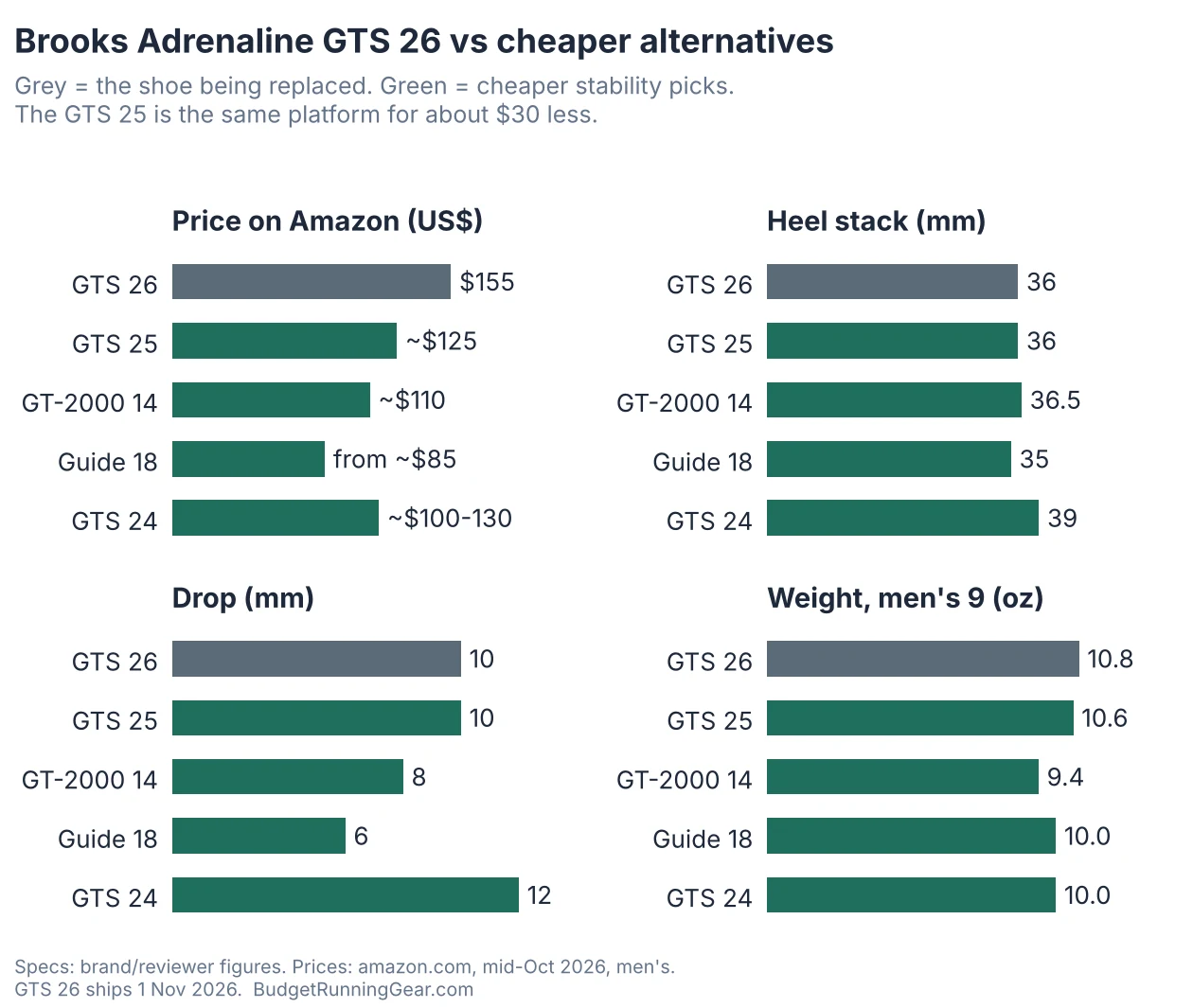
All the numbers in one place first, then what they mean below.
| Shoe | Buy on Amazon | Typical price (Amazon) | You save vs GTS 26 | Heel stack | Drop | Weight (men’s 9 / women’s 8) | Widths |
|---|---|---|---|---|---|---|---|
| Brooks Adrenaline GTS 26 | Men’s | Women’s | $155 | (reference) | 36mm | 10mm | ~10.8 / 9.6 oz | 4 |
| Brooks Adrenaline GTS 25 | Men’s | Women’s | ~$125 | ~$30 | 36mm | 10mm | ~10.6 / 9.4 oz | 4 |
| ASICS GT-2000 14 | Men’s | Women’s | ~$110 | ~$45 | 36.5mm | 8mm | ~9.4 / 8.3 oz | 4 |
| Saucony Guide 18 | Men’s | Women’s | from ~$85 | up to ~$70 | 35mm | 6mm | ~10.0 / 8.6 oz | 2 |
| Brooks Adrenaline GTS 24 | Men’s | Women’s | ~$100-130 | ~$25-55 | 39mm | 12mm | ~10.0 / — oz | 4 |
Stability Approach
- Adrenaline GTS 25/26: GuideRails, support that stays out of the way
- GT-2000 14: 3D Guidance, wide base and sidewalls
- Guide 18: CenterPath, wide base and sidewalls
- Adrenaline GTS 24: GuideRails with a firmer midsole
Heel-to-Toe Drop
- Adrenaline GTS 24: 12mm
- Adrenaline GTS 25/26: 10mm
- GT-2000 14: 8mm
- Guide 18: 6mm
If your calves or Achilles are sensitive, step down gradually rather than jumping straight from 12mm to 6mm.
Weight (Men’s)
- GT-2000 14: ~9.4 oz
- Guide 18: ~10 oz
- Adrenaline GTS 25: ~10.6 oz
- Adrenaline GTS 26: ~10.8 oz
Width Availability
- Adrenaline: four widths
- GT-2000 14: four widths
- Guide 18: regular and wide
Price (Amazon, Mid-October 2026)
- Adrenaline GTS 26: $155
- Adrenaline GTS 25: ~$125
- Adrenaline GTS 24: ~$100-130
- GT-2000 14: ~$110
- Guide 18: ~$85-105
When the Brooks Adrenaline GTS 26 Is Worth $155
- Your size or width has sold out in the GTS 25
- You found the GTS 25’s tongue or collar uncomfortable (those are the parts that changed)
- You simply want the newest version and the price doesn’t matter much to you
When Cheaper Alternatives Make More Sense
- You want the Adrenaline ride for less: Adrenaline GTS 25, about $30 saved
- You want lighter and bouncier: ASICS GT-2000 14
- You want a roomier fit, a lower drop or the lowest price: Saucony Guide 18
- You prefer a firmer, more traditional feel: Adrenaline GTS 24
The Bottom Line
Bottom line: of all the Brooks Adrenaline alternatives, the best deal for most Adrenaline runners right now is the Adrenaline GTS 25 at about $125. It’s the same platform as the new GTS 26, with an older tongue and collar. If you’re open to another brand, the ASICS GT-2000 14 (~$110) is lighter and livelier, and the Saucony Guide 18 (from ~$85) is the cheapest, with a roomier toe box and a much lower drop.
And whichever you pick, don’t wait too long. Outgoing models sell out size by size, and the common sizes go first. (Not sure your current pair is done? Here’s how long running shoes actually last.)
If you don’t actually need stability and just want more cushion, the Hoka Bondi alternatives and Brooks Ghost Max alternatives comparisons cover the max-cushion side. And if you’re newer to running and not sure you need a stability shoe at all, start with what actually matters in a beginner shoe.
Frequently Asked Questions
What is the best cheaper alternative to the Brooks Adrenaline?
The Adrenaline GTS 25. It shares the GTS 26’s stack, 10mm drop and GuideRails support and costs about $125, around $30 less. If you’d rather try another brand, the ASICS GT-2000 14 (~$110) is the closest match in support style, and it’s lighter.
What is the difference between the Adrenaline GTS 25 and GTS 26?
Mostly the upper. The GTS 26 adds a softer flat-knit tongue, a refreshed collar and a heel loop, and slightly re-tunes the DNA Loft v3 midsole. The stack, drop, support system and $155 list price stay the same.
Is the Adrenaline GTS 24 still worth buying?
Near $100, yes, if you liked it. It has a firmer ride and a 12mm drop. At $130, the GTS 25 is the better value.
Are there Brooks Adrenaline dupes?
If you mean a cheaper shoe that runs like the Adrenaline, the closest “dupe” is the Adrenaline itself, one version back (the GTS 25). Generic look-alike stability shoes rarely match the support, so stick with an established stability model like the GT-2000 14 or the Saucony Guide 18.
Brooks Adrenaline vs ASICS GT-2000: which is better?
They’re close in purpose. The GT-2000 14 is lighter, with bouncier foam and an 8mm drop. The Adrenaline has a 10mm drop and a fit long-time wearers know well. If the GT-2000’s narrower toe box works for your foot, it’s the lighter, livelier shoe. If not, stick with the Adrenaline.