

Short on time? These are the four Hoka Bondi alternatives I’d look at first. The full comparison is below.
Clearance stock and prices change quickly, so check your size. These are affiliate links: if you buy, I may earn a small commission at no extra cost to you. Disclosure.
Similar max cushioning with a firmer, more stable ride. About $95-110 since the Ghost Max 4 replaced it, so $60 or more under the Bondi.
Men’s on AmazonWomen’s on AmazonNear-Bondi stack with livelier foam and less weight. About $130, roughly $40 under the Bondi.
Men’s on AmazonWomen’s on AmazonA lighter, quicker Hoka with less stack than the Bondi. Around $140, and often less on sale.
Men’s on AmazonWomen’s on AmazonA highly cushioned daily trainer for about $90-110, roughly half the Bondi’s price.
Men’s on AmazonWomen’s on AmazonThe Hoka Bondi 9 costs $170. For a shoe that a lot of people buy as much for standing and walking as for running, that’s a steep number.
Through three and a half decades of running, I’ve watched Hoka grow from a fringe brand making funny-looking maximal trainers into one of the biggest names in the sport. The Bondi is the shoe that started it all for them on the road—their original, and still their plushest, max-cushion daily trainer. It has a devoted following among runners logging easy miles, and an even bigger one among nurses, teachers, and anyone else on their feet all day.
But $170 is a lot to ask, and the max-cushion category has filled up with strong Hoka Bondi alternatives. Several of them deliver a similar deep, protective ride for meaningfully less money. A few come from Hoka itself.
Here’s what the research, specs, and reviewer testing reveal about the best Bondi alternatives.
What’s in this comparison
What Makes the Hoka Bondi Popular
The Bondi has been Hoka’s cushioning flagship for over a decade. Knowing what it does well is the first step in judging whether a cheaper shoe can stand in for it.
Maximum stack, plush ride: The Bondi 9 carries roughly 43mm of foam under the heel—about as much as you’ll find in a daily trainer. Reviewer consensus is consistent: this is a deep, cloud-like ride built for soaking up impact rather than for speed.
New supercritical foam: Version 9 swapped the old compression-molded EVA for a supercritical foam. Testers describe the result as softer and more resilient than earlier Bondis, which had a reputation for feeling squishy and packing out over time. This is the real upgrade in the current model.
Signature Meta-Rocker: Hoka’s curved sole geometry rolls you through each stride, which is a big part of why a shoe with this much foam doesn’t feel like a brick. Reviews repeatedly credit the rocker for making the high stack manageable.
Low 5mm drop: Unusual for such a tall shoe. It keeps your weight balanced across the platform—one reason the Bondi is so often recommended for all-day standing.
Wide-foot friendly: The Bondi 9 comes in regular, wide, and extra-wide, and reviewers note the toe box finally runs true after years of the Bondi 8 feeling narrow. For wide feet, that width range is a real selling point.
Crossover appeal: This is central to understanding the Bondi. A large share of buyers aren’t racing in it—they’re walking, standing, and recovering. It’s routinely ranked the most comfortable walking shoe of the year, and it’s a common recommendation for plantar fasciitis and joint issues.
The reviewer verdict: Testers admire the comfort but flag two things—the weight (it’s one of the heavier trainers out there, around 10.4 oz and up) and the price. More than one review points out that competitors deliver similar cushioning, and sometimes better responsiveness, for less. The Bondi’s premium rides as much on brand and reputation as on anything happening underfoot.
So the question isn’t whether the Bondi is comfortable. It plainly is. The question is whether that comfort is worth $170 when the alternatives below get you most of the way there for less.
Four Cheaper Hoka Bondi Alternatives Worth Considering
Based on reviewer testing, specifications, and current pricing, these four shoes are the strongest cheaper stand-ins for the Bondi. I’ll flag up front that I haven’t personally logged miles in each of these—what follows draws on reviewer consensus and specs, combined with my own experience of what actually matters in a cushioned shoe. Where I’m citing testers, I’ll say so.
1. Brooks Ghost Max 3 — ~$95-110
The best overall alternative.
Specifications (per reviewer testing):
- Stack: high max-cushion stack, close to the Bondi
- Drop: 6mm
- Weight: ~10.8 oz (men’s) — about the same as the Bondi
- Midsole: nitrogen-infused DNA Loft v3
The Brooks Ghost Max 3 is the shoe reviewers most often name in the same breath as the Bondi, and it now undercuts it by $60 or more.
What testers report: Reviewers who own both describe the Ghost Max as the more stable shoe, with a firmer, more grounded ride than the Bondi’s marshmallow softness. Its DNA Loft v3 foam is nitrogen-infused (the same category of modern foam as the Bondi’s), and testers found it breathes a touch better in warm weather.
The trade-offs: It’s firmer, so if you specifically want that sink-in Bondi softness, this isn’t quite it. And it’s a neutral shoe with only mild built-in stability, so it’s not a substitute for a true support shoe.
Best for: Most runners looking for max cushioning who’d welcome a more stable, more versatile ride—and $60 or more back in their pocket.
2. ASICS Novablast 5 — ~$130
The best value with bounce.
Specifications:
- Stack: ~41.5mm heel — near Bondi territory
- Drop: 8mm
- Weight: ~9.0 oz (men’s) — well under the Bondi
- Midsole: FF Blast Max
The ASICS Novablast 5 delivers nearly the same stack height as the Bondi with a livelier, bouncier personality—and at around $130, it’s about $40 less than the Bondi.
What testers report: Reviewers consistently call the Novablast the best-value max-cushion trainer. Its FF Blast Max foam returns more energy than the Bondi’s supercritical EVA, so where the Bondi soaks up impact, the Novablast gives some back. It’s noticeably lighter, too. One recurring note is that the outsole grip is only average on wet roads.
The trade-offs: The ride is bouncier and less planted than the Bondi’s—wonderful if you want some pep, less ideal if you want pure, stable plushness for walking and standing. Fewer width options, too.
Best for: Runners who want max-cushion protection but with energy return and low weight, for about $40 less than the Bondi.
3. Hoka Mach 6 — ~$140
The best lighter option from Hoka itself.
Specifications:
- Stack: moderate (lower than the Bondi)
- Drop: 5mm
- Weight: ~8.2 oz (men’s) — dramatically lighter
- Midsole: supercritical foam
If you like Hoka’s rocker feel but not the Bondi’s weight or price, the Hoka Mach 6 keeps you in the family for about $30 less—and it’s regularly discounted to around $110.
What testers report: Reviewers describe the Mach 6 as light, snappy, and responsive, with a lower-to-the-ground cushion bed and a firmer, more efficient push-off than the Bondi. Runners switching from Hoka’s plusher shoes routinely say the Mach 6 feels faster and more propulsive. It carries the same Hoka rocker DNA, so the ride will feel familiar.
The trade-offs: This is the important one—the Mach 6 is not a max-cushion shoe. It has meaningfully less foam than the Bondi, so if deep, sink-in cushioning is exactly what you’re after (especially for standing all day), this isn’t a direct swap. It’s the pick for runners who realize they wanted Hoka, not necessarily maximum stack.
Best for: Hoka fans who want a lighter, faster, cheaper shoe and don’t actually need the Bondi’s towering stack.
4. Skechers Max Cushioning — ~$90-110
The best deep-budget and all-day option.
Specifications:
- Stack: high, max-cushion profile
- Midsole: Skechers’ ULTRA GO / Hyper Burst foam (varies by model)
- Focus: plush comfort for walking, standing, and easy miles
The Skechers Max Cushioning line is the wildcard here, and it speaks directly to the large share of Bondi buyers who spend more time standing and walking than racing. It routinely costs half of what the Bondi does.
Why it belongs on this list: Remember that a huge portion of Bondi sales go to people who want cloud-like comfort for long shifts, travel, and recovery—not tempo runs. For that buyer, a highly cushioned Skechers at $90-110 covers the core need (deep, forgiving comfort underfoot) at a fraction of the cost. Reviewers rate the Max Cushioning line well for walking and all-day wear.
The trade-offs: Let me be plain about this one—it’s not a performance running shoe. It lacks the refined foam, rocker geometry, and structure that serious runners will want for faster or longer efforts. Treat it as a walking-and-easy-miles alternative, not a training-and-racing one.
Best for: Budget-focused buyers who mainly want the Bondi for comfort, walking, and standing—and would rather not spend $170 to get it.
Head-to-Head Comparison: What You’re Trading
All the numbers in one place first, then what they mean below.
| Shoe | Buy on Amazon | Typical price (Amazon) | You save vs Bondi 9 | Heel stack | Drop | Weight (men’s 9 / women’s 8) | Widths |
|---|---|---|---|---|---|---|---|
| Hoka Bondi 9 | Men’s | Women’s | $170 | (reference) | 43mm | 5mm | ~10.5 / 9.3 oz | 4 |
| Brooks Ghost Max 3 | Men’s | Women’s | ~$95-110 | ~$60-75 | 39mm | 6mm | ~10.8 / 9.7 oz | 3 |
| ASICS Novablast 5 | Men’s | Women’s | ~$130 | ~$40 | 41.5mm | 8mm | ~9.0 / 7.9 oz | 2 |
| Hoka Mach 6 | Men’s | Women’s | ~$140 | ~$30 | 37mm | 5mm | ~8.2 / 6.9 oz | 2 |
| Skechers Max Cushioning | Men’s | Women’s | ~$90-110 | ~$60-80 | varies by model | varies | varies | varies |
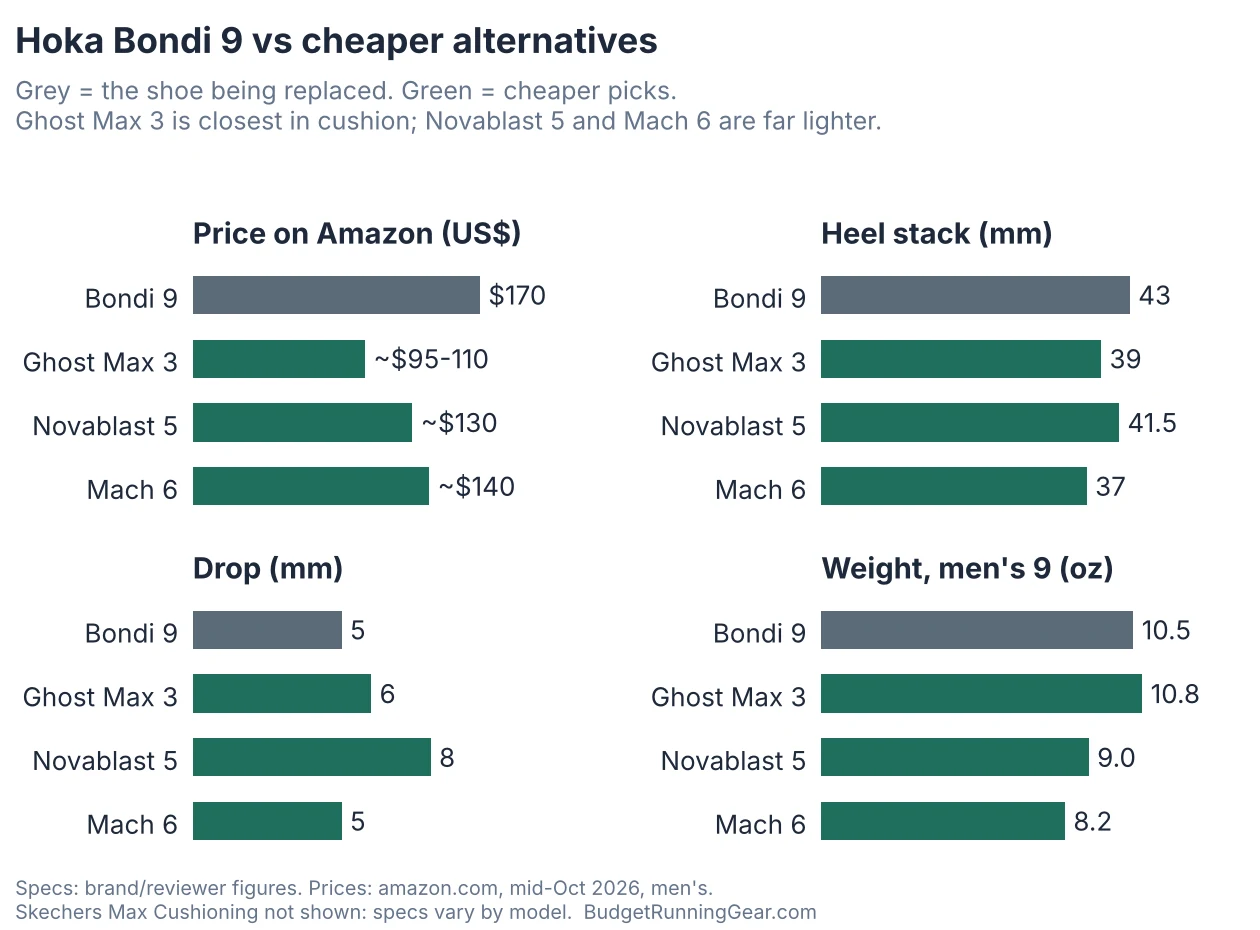
Here’s how these alternatives stack up against the Hoka Bondi 9.
Cushioning Volume
Bondi 9: ~43mm heel — maximum, cloud-like
Ghost Max 3: high max-cushion stack — close to the Bondi, a touch firmer
Novablast 5: ~41.5mm heel — near-Bondi stack, bouncier
Mach 6: moderate — noticeably less foam
Skechers Max Cushioning: high — plush, though less refined
Analysis: The Ghost Max 3 and Novablast 5 come closest to matching the Bondi’s stack. The Mach 6 deliberately offers less. The Skechers has plenty of foam but a simpler build.
Weight
Bondi 9: ~10.5 oz — heavy for a daily trainer
Ghost Max 3: ~10.8 oz — about the same
Novablast 5: ~9.0 oz — noticeably lighter
Mach 6: ~8.2 oz — dramatically lighter
Skechers: varies, generally lighter than the Bondi
Analysis: The Bondi and the Ghost Max 3 are the heavyweights here. The Novablast 5 and Mach 6 are substantially lighter. Over an hour-plus on foot, that difference adds up.
Ride Character
Bondi 9: soft, planted, rockered — built for easy miles and standing
Ghost Max 3: firmer, more stable, more versatile
Novablast 5: bouncy, energetic, livelier
Mach 6: snappy, low-to-ground, faster
Skechers: soft and comfort-first, not performance-tuned
Analysis: Only the Ghost Max 3 and Skechers really chase the Bondi’s plush, comfort-first identity. The Novablast and Mach 6 trade some of that softness for energy and speed.
Price
Bondi 9: $170
Ghost Max 3: ~$95-110
Novablast 5: ~$130
Mach 6: ~$140, often ~$110 on sale
Skechers Max Cushioning: ~$90-110
Analysis: Every option undercuts the Bondi, across a real range—from about $30 on the Mach 6 to roughly half price on the Skechers.
When the Hoka Bondi IS Worth $170
The Bondi earns its price in specific cases:
1. You want the softest, most protective ride, full stop. Nothing here quite matches the Bondi’s deep, sink-in plushness combined with a stable, wide base. For runners with joint issues or a real need for maximum impact protection, that matters.
2. You’re on your feet all day. The combination of huge cushioning and a balanced 5mm drop is why the Bondi is so often the top pick for nurses, teachers, and long shifts. It’s a category leader for standing comfort.
3. You need wide or extra-wide. The Bondi’s width range beats most of these alternatives. If standard widths don’t fit you, that alone can justify it.
4. You value the rocker and brand consistency. If you’ve worn Bondis for years and they’ve kept you running, the familiarity is worth something—switching platforms always carries a small injury risk.
When Cheaper Alternatives Make More Sense
For most other buyers, one of the four below delivers most of the Bondi experience for less:
Best overall—Brooks Ghost Max 3 (~$95-110):
Similar max cushioning, more stable, more versatile, $60+ cheaper. The closest all-round match.
Best value with energy—ASICS Novablast 5 (~$130):
Near-Bondi stack with real bounce and low weight, about $40 under the Bondi.
Best lighter Hoka—Hoka Mach 6 (~$140):
Same brand feel, far lighter and faster, cheaper—if you don’t truly need max stack.
Best deep-budget and walking pick—Skechers Max Cushioning (~$90-110):
Plush comfort for walking, standing, and easy miles at roughly half the Bondi’s price.
The Bottom Line
The Hoka Bondi 9 is a wonderful cushioned shoe. Its supercritical foam, rocker ride, and wide-foot options are the real thing, and for all-day comfort it’s close to the top of the category.
But at $170, it’s priced at a premium, and the best Hoka Bondi alternatives keep undercutting it. Reviewer consensus is steady on this point: you can get similar (or livelier) cushioning, in a lighter shoe, for less.
Recommendation hierarchy:
- Brooks Ghost Max 3 (~$95-110): Best overall—close cushioning, more stable, cheaper
- ASICS Novablast 5 (~$130): Best value with bounce and low weight
- Hoka Mach 6 (~$140): Best lighter Hoka, if you don’t need max stack
- Hoka Bondi 9 ($170): Still the pick for the softest ride, all-day standing, or wide feet
- Skechers Max Cushioning (~$90-110): Best deep-budget option for comfort and walking
For most runners drawn to the Bondi, the Ghost Max 3 gets you there for less. The Bondi remains a lovely shoe—it’s simply no longer the only way to get that max-cushion feel.
Frequently Asked Questions
What is the best cheap alternative to the Hoka Bondi?
The Brooks Ghost Max 3 (~$95-110) is the closest all-round match—similar maximum cushioning, but more stable and $60 or more cheaper. If you want more energy, the ASICS Novablast 5 delivers near-Bondi stack with a bouncier ride for around $130.
Is the Hoka Bondi worth $170?
For the softest possible ride, all-day standing, or wide feet, it can be. For most runners, cheaper alternatives deliver similar cushioning—reviewer testing repeatedly points out that shoes like the Ghost Max 3 and Novablast 5 offer comparable comfort, less weight, and better energy return for less money. The Bondi’s price reflects its reputation as much as its performance.
What’s the difference between the Hoka Bondi and the Hoka Clifton?
The Bondi is Hoka’s maximum-cushion flagship—more foam, softer, heavier, lower drop, built for easy miles and standing. The Clifton is lighter and more versatile, better suited to picking up the pace. If you want the plushest possible ride, the Bondi; if you want one shoe that can do a bit of everything, the Clifton. (We compared the Clifton against its own cheaper rivals in a separate guide.)
Is the Hoka Bondi good for walking and standing all day?
Yes—it’s one of the most-recommended shoes for exactly that, thanks to its deep cushioning and balanced 5mm drop. But if walking and standing is your main use, a plush Skechers Max Cushioning shoe at $90-110 covers that need for roughly half the price.
Is the Hoka Bondi good for beginners?
It’s comfortable and protective, which beginners appreciate, but it’s heavy and one-paced. A lighter, more versatile option like the Brooks Ghost Max 3 or ASICS Novablast 5 is often a better first shoe—and cheaper. Beginners are usually better served putting money toward a shoe that fits well than toward maximum stack height.
How long do Hoka Bondi shoes last?
Like most max-cushion daily trainers, the Bondi 9 typically delivers 400-500 miles of useful life. The supercritical foam in version 9 is more durable than the older EVA of previous Bondis, which tended to pack out sooner. As always, lifespan depends on your weight, stride, and the surfaces you run on.
Related Articles: